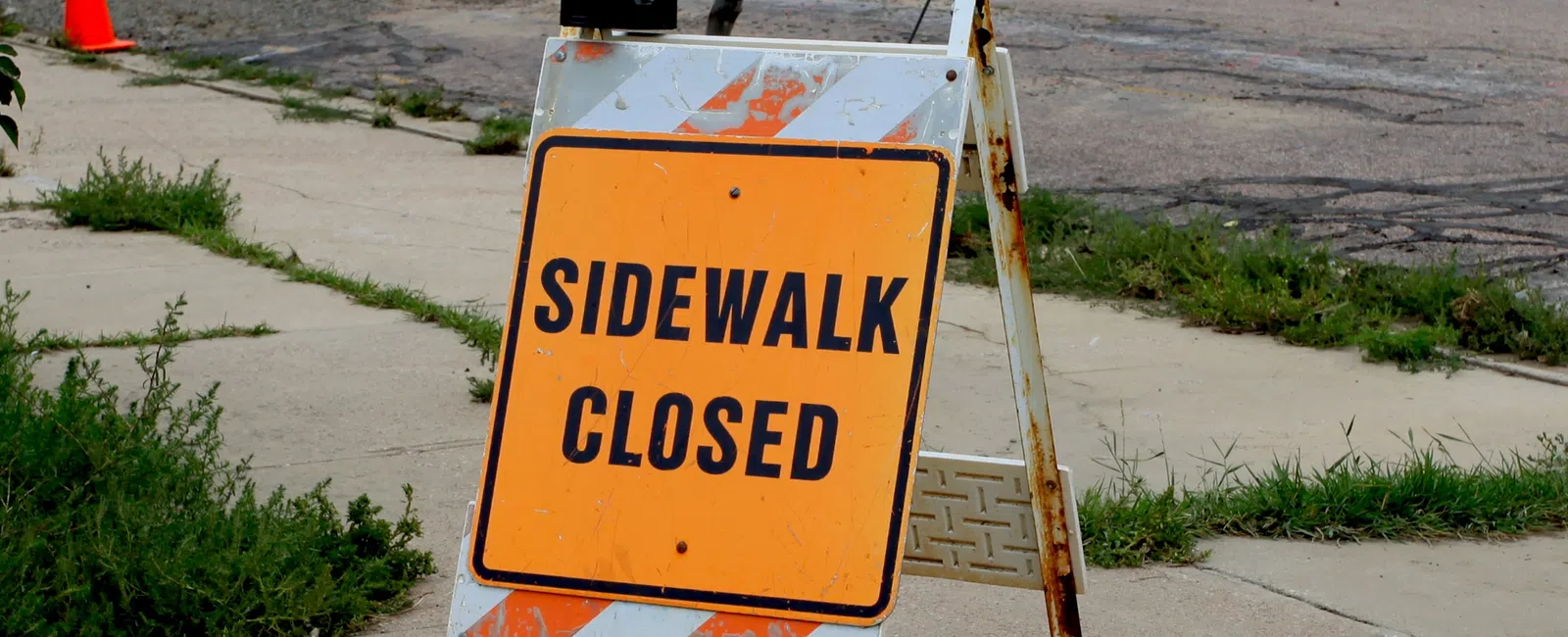
A SIDEWALK CLOSED sign does nothing for a pedestrian who cannot see it. MUTCD Part 6 addresses that directly, requiring a barrier that a cane can detect to be placed across the full width of the closed walk, because the sign alone does not close anything.
That requirement is where pedestrian traffic control fails most often, usually on jobs where the vehicle side was planned carefully, and the sidewalk was handled with whatever was left on the truck.
What Pedestrian Traffic Control Covers
Pedestrian traffic control is the part of a work zone setup that governs foot traffic. Vehicles get taper math and sign spacing. Pedestrians get accessibility requirements, because any route replacing a public sidewalk has to work for someone using a wheelchair or a cane.
Two terms carry the weight. A pedestrian access route is the continuous accessible path through the public right-of-way. PROWAG, the Public Right of Way Accessibility Guidelines published by the U.S. Access Board, sets the dimensions it has to meet. Close a sidewalk, and whatever replaces it gets measured against those numbers.
When a Job Triggers Pedestrian Routing
Any work occupying a sidewalk, a crosswalk, or the space above one puts pedestrian traffic control in scope. The common triggers:
- Sidewalk, curb, and curb ramp replacement, where the walk is the work area.
- Utility cuts crossing a walk, which close it in short segments over several days.
- Building facade, roofing, and crane work, where the hazard sits overhead rather than at grade.
- Lane closures that push equipment or material onto the shoulder pedestrians were using.
- Special events and road races, where rolling closures move the route by the hour instead of by the phase.
The first two get planned for. The last three are where a sidewalk closure appears late, after the vehicle side of the setup is already staked.
The Signs That Mark a Closure
MUTCD Section 6G.10 covers four regulatory signs. Each answers a different question about where pedestrians go next.
- R9-9, SIDEWALK CLOSED, at the beginning of the closed section and at the intersections before it.
- R9-10, SIDEWALK CLOSED USE OTHER SIDE, where a parallel sidewalk exists across the roadway.
- R9-11, SIDEWALK CLOSED AHEAD CROSS HERE, moving pedestrians across the street before they reach the closure.
- R9-11a, SIDEWALK CLOSED CROSS HERE, just past the point where pedestrians are redirected.
Where foot traffic is rerouted rather than stopped, the Pedestrian Detour sign M4-9b or the Bicyclist/Pedestrian Detour sign M4-9a carries the route. These follow the same placement logic as other temporary construction signs: the sign goes where the decision gets made, not where the work starts.
Width, Edging, and Clearance
A temporary pedestrian route has to meet four requirements:
- Continuous clear width of 48 inches minimum, measured without the curb.
- Passing spaces at intervals along any stretch narrower than 60 inches.
- Continuous detectable edging a cane can track end to end. Tape, rope, and plastic chain do not qualify, and MUTCD names all three.
- No sign or device mounted under seven feet projecting more than four inches into the path.
The surface counts as well. A temporary facility is expected to carry the accessibility features of the sidewalk it replaces, so a gravel shoulder or a worn path across a lawn does not meet the standard.
Three device types hold a pedestrian route:
- Longitudinal channelizing devices, which interlock into a continuous trackable edge.
- Detectable barricades, which mount the closure signs and block entry at intersections.
- Chain link fencing with a bottom rail, used where a closure runs for weeks.
Most contractors pull these from a traffic control equipment rental rather than buying a wall of them for one job. Cones and drums are not substitutes, because a cone sweeps between them.
Closing the Walk Versus Keeping Pedestrians Moving
MUTCD guidance is to preserve pedestrian routes in urban and commercial suburban areas and to discourage alternative routing. The reason is practical. A detour that adds two street crossings creates conflict points the original route never had, and pedestrians who find it inconvenient walk into the work area or the roadway instead.
The stronger option on most sites is a temporary walkway carried past the work area inside a closed parking lane or shoulder, separated by a temporary barrier where vehicle incursion is a real risk. It costs roadway width, which is the tradeoff contractors resist and reviewers expect to see addressed on the drawing.
When a walkway will not work, the closure becomes a detour, and how the detour gets set up decides whether anyone follows it. The closed sidewalk has to be barricaded at every intersection feeding into it, not only at the work area, or pedestrians enter mid-block and reach a dead end with no accessible way to turn around.
Where Approval Comes From
Sidewalks sit in local right-of-way in most cases, so the permit comes from a city or county public works office rather than a state DOT district office. State involvement usually begins where the sidewalk runs along a state route. Either way, the pedestrian route belongs on the drawing submitted with the permit, showing:
- Clear width of the temporary route at its narrowest point.
- Device type along each edge.
- The detour path, where the route leaves the block.
- Any crossing pedestrians are being directed to use.
That detail is what generic plan sets leave out, and it is one reason template plans get rejected. A downloaded layout shows a lane closure on open roadway with no sidewalk in the frame. Reviewers working in developed corridors look for the pedestrian route first, and a complete traffic control plan treats it as a designed element rather than a note.
AQC Traffic Control designs and sets up pedestrian routing as part of lane closure and traffic control plan work across Georgia, Alabama, Florida, South Carolina, Tennessee, and North Carolina, including the detectable barricades, edging, and signs the approved plan calls for. Call 470-480-0348 to get the pedestrian route on the drawing before the permit application goes in.