A merge sign warns drivers that two lanes or roadways are about to become one, so traffic must adjust speed and spacing to merge. It gives drivers time to plan for the conflict point, whether that is a highway on-ramp, a permanent lane drop, or a work zone taper.
Several versions exist, and the differences matter more than most drivers realize.
What Does a Merge Sign Mean?
The standard Merge sign (MUTCD W4-1) is a diamond showing a straight line with a second line curving into it from the side. It appears where an entering roadway joins the main road, and the curved line shows which side the new traffic comes from.
On the main road, it means vehicles are about to appear beside you. On the entering road, it means you need to match speed and find a gap.
Merge Sign vs. Lane Ends Sign
These two signs look alike and mean different things. A Merge sign tells you a separate roadway is joining yours. A Lane Ends sign (W4-2) tells you one of the lanes you are already traveling in is going away. Its symbol shows one edge line bending inward to close off a lane.
The practical difference is who has to move. At a Merge sign, entering traffic adjusts. At a Lane Ends sign, drivers in the ending lane move over before it disappears.
Types of Merge and Lane Ends Signs
The Manual on Uniform Traffic Control Devices (MUTCD), the federal standard for signs on public roads, includes a family of merge-related warning signs:
- The Merge sign (W4-1) is a symbol sign for an entering roadway joining the main road.
- The Lane Ends sign (W4-2) is a symbol sign showing a through lane ending, mirrored for the left or right side.
- The RIGHT (LEFT) LANE ENDS sign (W9-1) is the word-message version of the lane-drop warning.
- The LANE ENDS MERGE LEFT (RIGHT) sign (W9-2) tells drivers that the lane ends and which direction to move.
- The RIGHT (LEFT) LANE CLOSED AHEAD sign (W20-5) warns that a lane is closed for work, often with a distance such as 1500 FT.
- The THRU TRAFFIC MERGE LEFT (RIGHT) sign (W4-7) is used in work zones where through traffic has to shift over while turning traffic does not.
- The CENTER LANE CLOSED AHEAD sign (W9-3) appears when work occupies a middle lane, and traffic splits around it.
Drivers often call any of these a lane reduction sign. On the contractor side, the code matters, because the traffic control plan specifies exactly which sign goes where.
Merge Left and Merge Right Signs
"Merge left" and "merge right" describe direction, not a separate type of sign. The Lane Ends symbol is mirrored depending on which lane is dropping. The LANE ENDS MERGE LEFT sign spells it out in words.
In a work zone, a flashing arrow board usually reinforces the direction at the start of the taper. When the arrow points left, the right lane is closed; anyone in it needs to be out before the cones or drums begin.
What Color Is a Merge Sign?
Permanent merge and lane ends signs are yellow diamonds with black symbols or lettering. Yellow marks a permanent warning.
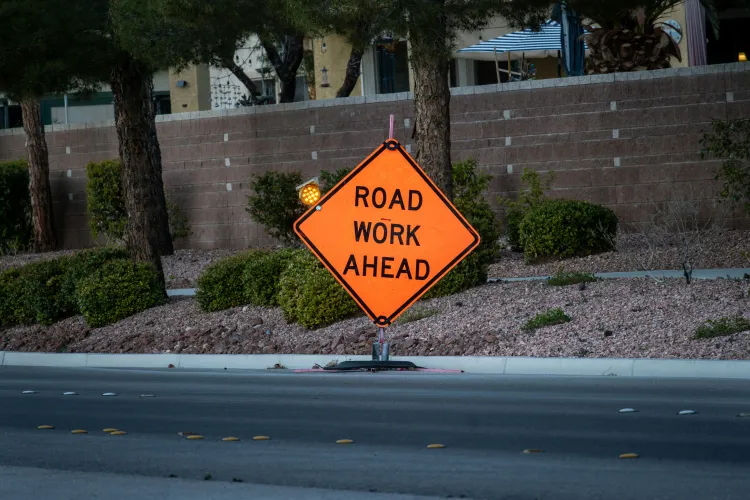
In a construction or maintenance zone, the same signs are orange with black lettering. Orange marks temporary traffic control, so an orange Lane Ends sign tells you the lane drop exists only because of the work ahead. Responders clearing a crash or spill may use fluorescent pink versions, which signal an unplanned incident instead of scheduled work.
How to Merge Correctly When You See the Sign
Match the speed of the lane you are moving into, signal early, and choose a gap instead of forcing one. Stopping at the end of an on-ramp or closing lane is risky because traffic behind you expects you to keep rolling.
What Is a Zipper Merge?
A zipper merge, also called a late merge, has drivers use both lanes at the merge point and then take turns, one vehicle from each lane. In heavy Lane traffic, it shortens the backup and evens out speeds between lanes.
The 11th edition of the MUTCD added guidance on late merge strategies for work zones, and some agencies now post a MERGE HERE TAKE TURNS sign (W9-2a) at the merge point. When traffic is light and moving at highway speed, an early merge is usually smoother. The signs on the road tell you which approach the agency wants.
Lane Closed Ahead Signs in Work Zones
Most merge signs drivers complain about sit in work zones. On a multilane road, a lane closure is signed in a set order so drivers get several warnings before they reach the cones.
A typical right lane closure follows this sequence:
- ROAD WORK AHEAD (W20-1), the first notice that a work zone is coming.
- RIGHT LANE CLOSED AHEAD (W20-5), usually posted with a distance and often repeated closer to the work.
- The Lane Ends symbol (W4-2), placed in advance of the merge.
- A flashing arrow board and a taper of cones or drums that physically closes the lane.
- END ROAD LANE (G20-2), once traffic is clear of the work area.
Exact spacing depends on speed and road type, and it comes from the traffic control plan, not a guess on the day of the closure.
What It Takes to Set Up a Work Zone Merge
The taper is where the merge physically happens, and its length is calculated. The MUTCD bases merging taper length on posted speed and lane width. For speeds of 45 mph or higher, the formula is lane width multiplied by speed, so closing a 12-foot lane on a 55 mph road calls for a 660-foot taper. For speeds of 40 mph or less, it is lane width multiplied by speed squared, divided by 60.
A merge that works on paper can still fail on the road. A solid lane closure accounts for:
- Sign spacing that gives drivers enough distance to react at the speed traffic actually travels.
- Sight distance to the taper, since a merge hidden over a hill crest or around a curve leaves no time to move over.
- Channelizing devices spaced closely enough that the closed lane reads as a closed lane, day and night.
- Traffic volume by time of day, because a closure that flows at 10 a.m. can back up for miles at 5 p.m.
- Regular inspection, since knocked-over drums and turned signs are common once traffic starts brushing the taper.
How AQC Handles Lane Closures and Merges
AQC Traffic Control sets up and manages the lane closures that require these signs. Our flagging and lane closure crews are ATSSA-certified and handle everything from single-lane maintenance work to multi-phase road closures. Our traffic control plans and permitting team develops MUTCD-compliant plans, including sign placement and taper layout, and coordinates permits with state and local agencies.
If your crew is running its own closure, our equipment rental inventory includes arrow boards, changeable message signs, cones, channelizers, barricades, and road closure signs, with delivery and setup assistance. When a crash or utility failure forces an unplanned closure, our emergency response team mobilizes 24/7.
Planning a lane closure? Request a quote or call 470-480-0348 to talk with our team.
Merge Sign FAQs
What does a merge sign mean?
Two lanes or roadways are about to join into one, so drivers should adjust speed and spacing.
Who has the right of way when merging?
Generally, the vehicle already in the lane. The driver changing lanes or leaving an ending lane is expected to find a safe gap.
What is the difference between a merge sign and a yield sign?
A yield sign (R1-2) is a regulatory sign that legally requires you to give the right of way. A merge sign is a warning sign that alerts you to merging traffic.
Why are some merge signs orange?
Orange marks temporary traffic control. The lane is closed for construction, utility, or maintenance work and will reopen when the work is done.