Most contractors calling for a lane closure have a date, a location, and a crew that needs to get in the road. What they often do not have is a clear picture of the four separate pieces that make the closure legal and functional, or which of those pieces they are expected to supply themselves.
Duration Drives Almost Everything
Before anything else gets decided, the work has to be classified by how long it occupies the location. The MUTCD, the Manual on Uniform Traffic Control Devices that every state builds its work zone rules from, defines five categories in Section 6N.01 and treats duration as the primary factor in determining how many devices a zone needs and which types.
- Long-term stationary, meaning work that occupies a location more than three days
- Intermediate-term stationary, meaning work spanning more than one daylight period up to three days, or nighttime work lasting more than an hour
- Short-term stationary, meaning daytime work that occupies a location more than an hour within a single daylight period
- Short duration, meaning work that occupies a location up to an hour
- Mobile, meaning work that moves intermittently or continuously
That classification is not paperwork. Because long-term and intermediate-term operations extend into nighttime, the MUTCD requires retroreflective or illuminated devices in those zones. A crew that told the office "one day" but is actually working past dark has just changed which devices the setup requires. Most utility and maintenance operations fall into the short-term stationary category, which is why the same crew can run very different setups from week to week.
The Four Pieces of a Closure
A lane closure is not a delivery of cones. It is four things that have to line up.
- The plan. Depending on the roadway and the agency, that means either a project-specific traffic control plan or a documented reference to a standard typical application, plus whatever permit the right-of-way owner requires. City, county, and state jurisdictions on the same corridor have different reviewers and different lead times, and the plan has to satisfy the one that actually owns the road.
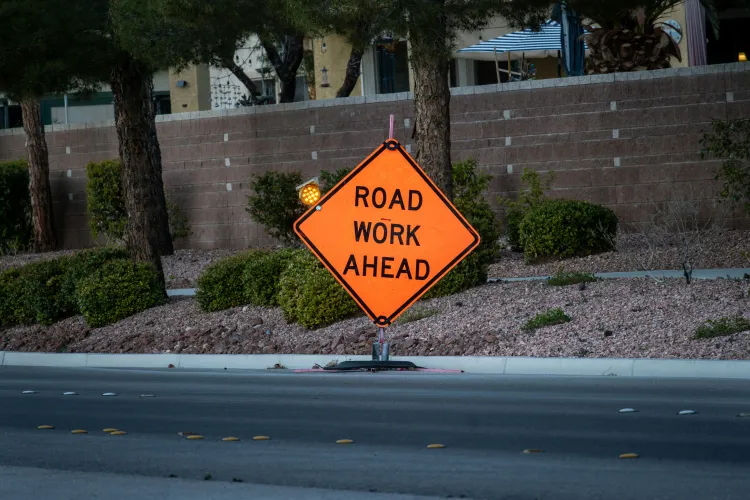
- The devices. Advance warning signs, the channelizing devices that form the taper, and whatever supplemental equipment the conditions call for, such as an arrow board on a higher-speed road or a message sign for a closure drivers need warning about days ahead.
- The crew. Some closures need certified flaggers controlling alternating traffic. Others need only devices, with no one directing movement. A smaller set needs sworn law enforcement.
- Monitoring. The MUTCD calls for someone knowledgeable in temporary traffic control to be responsible for safety in the zone, with their most important duty being to confirm that devices in the field still match the plan. Setups drift over a shift. Cones get knocked, signs rotate, and the taper that was correct at seven in the morning is often not correct by noon.
Flaggers, Devices Only, or an Officer
The most common question on a closure request is whether flaggers are needed, and the answer depends on what traffic has to do.
If the closure removes a lane but leaves an open lane in each direction, drivers merge on their own and the devices do the work. If the closure forces opposing directions to share a single lane, someone has to control alternating movement, and that is flagging. Two-lane roads reduced to one almost always fall into this category.
Off-duty officers occupy a narrower band. They are used where a sworn presence is required, typically at signalized intersections where signal timing has to be overridden, on municipal projects that specify law enforcement in the permit conditions, or where drivers are unlikely to comply with civilian direction. Officers are not a general upgrade over flaggers, and the specifics of when and how to arrange one matter more than the assumption that more authority is always better.
Getting this wrong in either direction creates problems. Ordering flaggers for a closure that does not need them puts people in the road for no reason. Skipping them on a closure that does need them leaves drivers to negotiate a single shared lane without direction.
Equipment Only Versus a Managed Setup
Some contractors have crews trained to place devices and want equipment delivered. Others want the closure set, maintained, and taken down by someone else so their crew stays on the actual work.
Both are legitimate, but the responsibility split needs to be settled before the truck arrives. Equipment rental means the devices show up and the placement, spacing, monitoring, and takedown belong to the contractor. A managed setup means the traffic control provider handles placement and stays with it. The middle ground, where equipment is dropped and everyone assumes the other party is watching the taper, is where compliance problems start.
What to Have Ready When You Call
- The exact roadway, the jurisdiction that owns it, and the posted speed limit, since spacing and taper length are calculated from speed
- Realistic start and end times, including whether any portion of the work runs after dark
- What traffic has to do at the closure, meaning whether an open lane remains in each direction or opposing traffic has to share one
Those three answers determine the plan, the device list, and the crew. Without them, any quote is a guess that gets revised once someone sees the site.
AQC Traffic Control handles lane closures across Georgia, Alabama, Florida, South Carolina, Tennessee, and North Carolina, including plan development and agency coordination, ATSSA-certified flaggers, off-duty officer coordination, and equipment rental for crews that set their own zones. Emergency closures are covered around the clock. Call 470-480-0348 to walk through what your project needs.