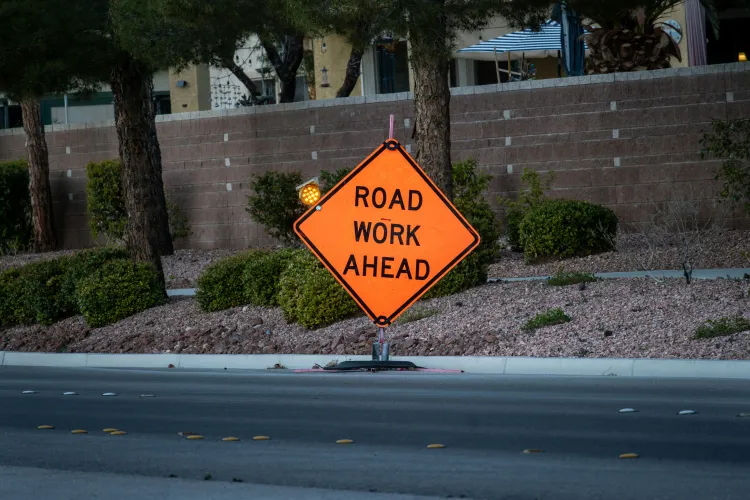
Proper traffic control sign placement is one of the most overlooked factors in work zone safety, and it carries direct consequences for both drivers and road crews. A sign accomplishes nothing unless a driver sees it with enough time and distance to react, which means placement matters just as much as the sign itself. When the spacing, sequence, or positioning is wrong, even the brightest and most reflective orange panel fails to do its job and leaves everyone at the site exposed to greater risk.
At AQC Traffic Control, we have seen across many projects that a correctly configured work zone keeps crews safe and keeps traffic moving smoothly, while a poorly configured one creates confusion and increases the likelihood of a collision.
Why Sign Placement Is About Timing and Distance
A merging traffic sign posted only fifty feet before a lane closure gives a driver almost no room to merge safely, while the same merge sign posted several hundred feet ahead allows that driver to check a mirror, signal, and ease over without braking suddenly. Spacing is governed by the Manual on Uniform Traffic Control Devices, which serves as the national standard for how and where these devices are positioned, and it requires greater distance between warnings as road speeds increase. A vehicle traveling at sixty miles per hour covers roughly eighty-eight feet every second, meaning a small reduction in warning distance removes a meaningful amount of reaction time.
The Sequence That Keeps a Work Zone Safe
A well-designed work zone presents its information in a deliberate order so that drivers are guided through each stage without any sudden surprises.
- Advance warning. A road construction sign or road work sign appears first and alerts drivers that conditions ahead are about to change, establishing the earliest point of awareness.
- Transition. Merge signs and a merging traffic sign then guide vehicles out of the closed lane in a controlled manner rather than forcing a last-second adjustment near the hazard.
- Human direction. A flagger ahead sign warns drivers that a person is directing traffic further along, prompting them to slow down and prepare to stop well in advance.
- Closure point. A road closed sign or barricade finally marks the location where the road is genuinely impassable, removing any remaining ambiguity about where vehicles can travel.
Common Placement Mistakes That Cause Crashes
Even experienced crews make placement errors, and the same mistakes tend to recur across job sites.
- Signs positioned too close to the hazard. A merge sign that becomes visible only after the lane has already narrowed cannot give a driver enough room to respond.
- Incorrect sequencing. Displaying a road closed sign before any advance road construction sign removes the early warning that a driver needs in order to slow down gradually.
- Obstructed or hidden signs. A panel placed behind a parked truck or surrounded by roadside vegetation provides almost no value because drivers cannot see it clearly.
- Signs left in place after the work ends. Signs that remain standing once a project is complete train drivers to disregard them, which becomes dangerous when the next warning is genuine.
How Correct Placement Reduces Risk for Everyone Involved
The worker holding the flagger ahead sign relies on the assumption that approaching drivers received fair warning further back along the road. The commuter relies on the merging traffic sign to provide enough notice to move over safely. The contractor relies on the entire system to prevent injuries and to keep the project on schedule.
Clear merge signs prevent the side-impact collisions that occur when two lanes are forced to combine without sufficient guidance, and a visible road closed sign prevents a driver from continuing through a barricade into an active excavation area. A properly positioned road construction sign also establishes the appropriate speed and level of attention before anyone reaches the crew. Beyond the safety benefits, there is a strong operational case for getting this right, because work zone crashes produce stoppages, liability exposure, and fines for non-compliance. A setup that follows the national standards keeps a project both legal and productive, which is why many utility, power, telecom, and paving contractors choose to assign this responsibility to a dedicated traffic control partner.
Why Professional Traffic Control Makes the Difference
Placing a few signs along a roadway is straightforward, but configuring involves knowing the correct spacing for each posted speed limit, developing a compliant traffic control plan, securing the appropriate permits, and adjusting the setup as conditions change throughout the day.
At AQC Traffic Control, this work represents our entire area of focus and expertise. We handle flagging, lane closures, sign placement, traffic control plans, permitting, and around-the-clock emergency response so that your crew can concentrate fully on the project itself. Whether the assignment involves a planned utility installation or a sudden roadway emergency during overnight hours, we make certain that every road construction sign, merge sign, and flagger ahead sign is positioned exactly where the standards require it to be.
Keep Your Work Zone Safe and Compliant
Proper traffic control sign placement is not a procedural formality, because it directly determines whether a work zone results in a smooth detour or a serious collision. The correct signs, arranged in the correct order and spaced at the correct distances, provide drivers with the time they need to react and protect everyone who passes through or works within the zone.
Contact AQC Traffic Control today for dependable, around-the-clock traffic control support. Our team responds quickly to help keep your crews safe, traffic moving efficiently, and projects on schedule. Reach out to request a quote or schedule service.