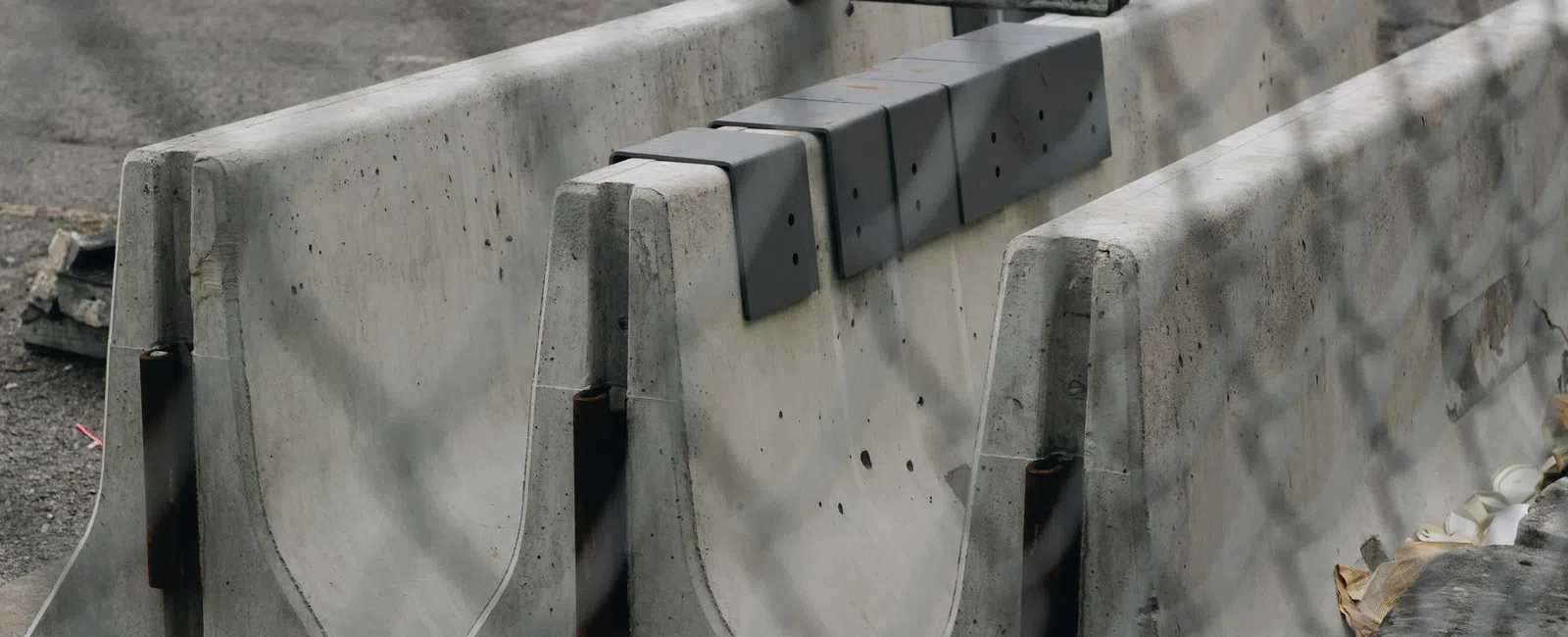
If you have driven past a highway work zone, a stadium entrance, or a lane split during rush hour, you have seen a Jersey barrier. It is the sloped concrete wall that separates you from oncoming traffic or a crew working a few feet away. Most drivers never think twice about it, but the shape of that wall is the result of decades of crash testing, and it does a very specific job: it keeps an out-of-control vehicle from crossing into oncoming lanes or plowing into a work area.
Jersey Barrier Basics
A Jersey barrier is a modular wall, usually made of steel-reinforced concrete or heavy-duty plastic, built to separate or redirect traffic. The standard version stands 32 inches tall with a wide base that tapers to a narrower top. That profile is not for looks. When a vehicle hits it at a shallow angle, the tires ride up the lower slope, which lifts and redirects the vehicle back into its lane instead of stopping it dead or launching it over the top.
The barrier gets its name from New Jersey, where the state highway department developed and refined the design in the 1950s. The shape worked so well that it spread nationwide, and today almost any barrier with that profile gets called a Jersey barrier regardless of where it was made.
How the Shape Redirects a Vehicle
The genius of the design is in the slope. A Jersey barrier does not try to be an immovable wall. Instead, it manages a collision in stages.
At a low impact angle, a sideswipe, the vehicle's tire contacts the lower sloped face first. That contact lifts the wheel slightly and reduces friction between the tire and the road, which banks the vehicle and steers it back toward its own lane. The driver often stays in control and damage stays minor.
At a steeper, higher-speed angle, the front bumper rides up the upper slope, the frame absorbs the hit, and the barrier's mass keeps the vehicle from crossing over or rolling. Crash testing has shown the profile can contain and redirect vehicles as large as tractor-trailers under the right conditions.
That staged response is why the Jersey profile outlasted every competing design. It reduces the severity of the crash instead of simply resisting it.
Concrete vs. Plastic Jersey Barriers
Not every job calls for the same barrier. The two main types serve different purposes, and choosing the wrong one is a common mistake on smaller projects.
| Feature | Concrete Jersey Barrier | Plastic Jersey Barrier |
|---|---|---|
| Best for | Permanent or high-speed installations | Short-term, low-speed, or channelizing work |
| Crash protection | High; rated for highway-speed impacts | Moderate; depends on water/sand fill |
| Weight | Very heavy; needs a truck and equipment to move | Light empty, fillable on site with water or sand |
| Portability | Low | High; two people can reposition an empty unit |
| Visibility | Gray concrete, sometimes with reflective tape | Usually bright orange or white, highly visible |
| Reusability | Durable but hard to relocate | Easy to move, drain, and redeploy |
| Typical use | Median dividers, long-term work zones | Event perimeters, lane channelizing, quick setups |
Concrete is the workhorse for anything permanent or anywhere vehicles move at highway speed. Plastic shines when a crew needs to set up fast, guide traffic at lower speeds, or pull everything down at the end of a shift. Plastic units get filled with water or sand on site to add mass, then drained before they are hauled off.
Standard Dimensions and Weight
Sizes vary by manufacturer and application, but the common reference points are worth knowing.
The standard height is 32 inches, though taller variants exist. Some states, including New York, Massachusetts, and New Jersey, use taller walls around 42 inches to block oncoming headlight glare and better contain large trucks. The base is typically about two feet wide, tapering toward the top.
Concrete units usually come in 4, 8, 10, and 12-foot lengths, with custom sizing available. Weight scales with size and material, so a short concrete section is manageable with equipment while a full 12-foot unit is a serious lift. Plastic units weigh little when empty and gain their working mass only once filled. Because weight and length drive how many barriers you need and how you transport them, these numbers matter as much for logistics as for safety.
When Work Zones Actually Use Them
Jersey barriers show up wherever traffic needs a hard separation from people or from oncoming lanes. Common scenarios include:
- Highway medians, separating opposing lanes to prevent head-on crossovers
- Construction and road work zones, shielding crews from live traffic
- Lane shifts and temporary rerouting during roadwork
- Event and venue perimeters, controlling vehicle access and protecting pedestrians
- Security applications, blocking vehicle access to sensitive or no-access areas
The decision to use a Jersey barrier instead of cones, drums, or lighter traffic barricades comes down to risk. When the consequence of a vehicle entering the work area is severe, or traffic is moving fast, a positive barrier like a Jersey wall is the right call. For low-speed delineation where you only need to guide drivers, lighter channelizing devices often do the job. Matching the device to the speed and the hazard is a core part of any traffic control plan.
Need Jersey Barriers for a Work Zone or Event?
Choosing the right barrier, sizing the run correctly, and placing it to actually protect a work area takes more than ordering a few walls. It takes a plan built around the speed of traffic, the hazard, and the layout of the site.
If you are running a project in Georgia or across the Southeast, AQC Traffic can spec, deliver, and set up the right barriers for the job, and build the traffic control plan around them. Take a look at our traffic control equipment rentals or call today to talk more at 470.480.0348.