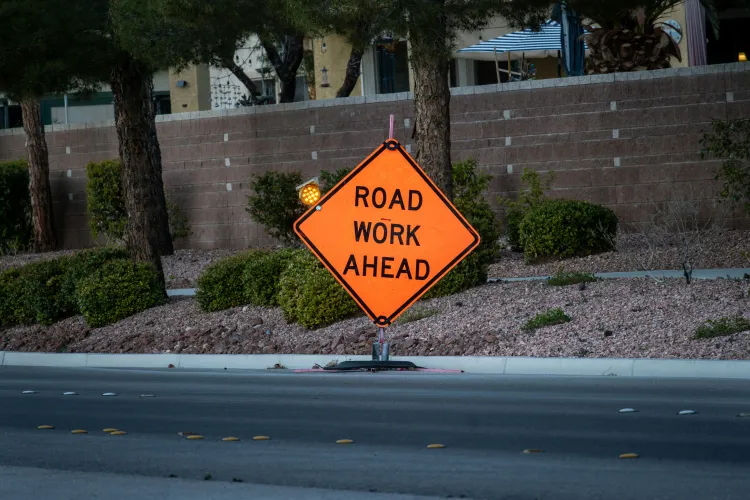
Crews often assume they can post a lower speed limit themselves. It is not. A regulatory limit inside a work zone carries the same legal weight as any other posted limit, and only the agency that owns the road can change it.
A contractor cannot lower a posted limit
Section 6G.01 of the MUTCD (Manual on Uniform Traffic Control Devices, the federal standard for traffic control devices) is a Standard rather than guidance: regulatory signs in a temporary traffic control zone must be authorized by the agency having jurisdiction. Section 2B.21 adds that a Speed Limit sign displays the limit established by law, ordinance, regulation, or adopted by the authorized agency based on an engineering study.
A reduced work zone limit is therefore a request. It moves through the traffic control plan and gets approved before the sign goes up. Bolting a 35 MPH sign to a barricade because traffic feels fast does not create an enforceable limit, though it does create liability if there is a crash in the zone.
One related requirement gets missed regularly. When a temporary zone needs regulatory measures different from what is already posted, the existing permanent signs have to be removed or covered so the temporary signs supersede them. Leaving a 55 MPH sign standing a few hundred feet from a temporary 45 MPH sign hands drivers two contradictory legal limits.
The MUTCD pushes back on reductions
Section 6B.01 is unusually direct on this point. Avoid reduced speed zoning as much as practical, because drivers slow down only when they clearly perceive a reason to. When a reduction is used, it should apply only to the specific portion of the zone where the restrictive condition exists, and avoid frequent changes in the limit.
The guidance sets a working ceiling of 10 mph. Plans should be designed so vehicles can travel through the zone with no more than that reduction, and anything larger should be used only when restrictive features genuinely require it, stepped down in advance of the lowest-speed location with additional warning devices and driver notification.
The manual explains the reasoning. Research cited in Section 6B.01 found that large reductions, on the order of 30 mph, increase speed variance and crash potential, while reductions of up to 10 mph produce less variance and have proven more effective. A limit nobody believes gets ignored, and the gap between drivers who obey it and those who don't causes collisions.
Advisory speed is not the same thing
This distinction decides whether you need agency approval at all.
An advisory speed plaque (W13-1P) mounted under a warning sign recommends a speed for a condition such as a lane shift, narrow lanes, or a rough surface. Section 6H.32 sets three limits: it cannot be used with anything other than a warning sign, it cannot be used alone, and, except in emergencies, it cannot be mounted until the highway agency determines the recommended speed. It is guidance, not an enforceable limit. A regulatory Speed Limit sign is enforceable and requires the authority described above. For many short-duration work activities, an advisory speed on a warning sign is both the appropriate tool and the faster one.
The signs that go with an approved reduction
Once an agency approves a reduced limit, the MUTCD provides a standard set of devices:
- Speed Limit (R2-1) sign, optionally with a WORK ZONE (G20-5aP) plaque mounted above it
- Reduced Speed Limit Ahead (W3-5) or XX MPH Speed Zone Ahead (W3-5a) in advance of the change
- END WORK ZONE SPEED LIMIT (R2-12) at the downstream end of the reduced zone
- BEGIN and END HIGHER FINES ZONE signs (R2-10, R2-11), or a FINES HIGHER, FINES DOUBLE, or dollar amount plaque below the Speed Limit sign, where the jurisdiction imposes increased fines
These can be combined into a single sign or displayed as an assembly.
What about when no workers are present
This is one of the most searched questions about work zone speed limits, and the MUTCD does not answer it. The manual governs when a reduction is appropriate and how it should be signed, not whether a posted limit stays enforceable once the crew has gone home. It does establish that a reduction should apply only to the portion of the zone where the restrictive condition exists, and that devices no longer appropriate for current conditions should be taken down. Both point toward taking a reduced limit out of service when the condition that justified it is gone.
The rest sits in state law and in the terms of the approval. Some states write worker presence into their statutes or into the conditions attached to a reduced limit, while others tie enforceability to the roadway's physical condition instead. That difference matters most on multi-state work, where a crew carries one state's assumption across a line. Confirm it with the reviewing agency and get it in writing if the zone will sit inactive on nights or weekends. Enforceability aside, leaving a reduced limit posted through weeks of inactivity teaches drivers the sign means nothing, and compliance drops on the days work is actually happening.
Where this gets decided
Speed is a plan decision, not a field decision. It gets settled when the traffic control plan is drawn and submitted, alongside sign spacing, taper lengths, and buffer space.
AQC Traffic Control develops compliant traffic control plans and works through the review process with the agencies having jurisdiction, then deploys ATSSA-certified crews across Georgia, Alabama, Florida, South Carolina, Tennessee, and North Carolina. Signage, cones, barricades, arrow boards, and message signs are available as rentals with delivery.
If the posted speed is a concern on your project, call 470-480-0348 or request a quote.